404 Lab
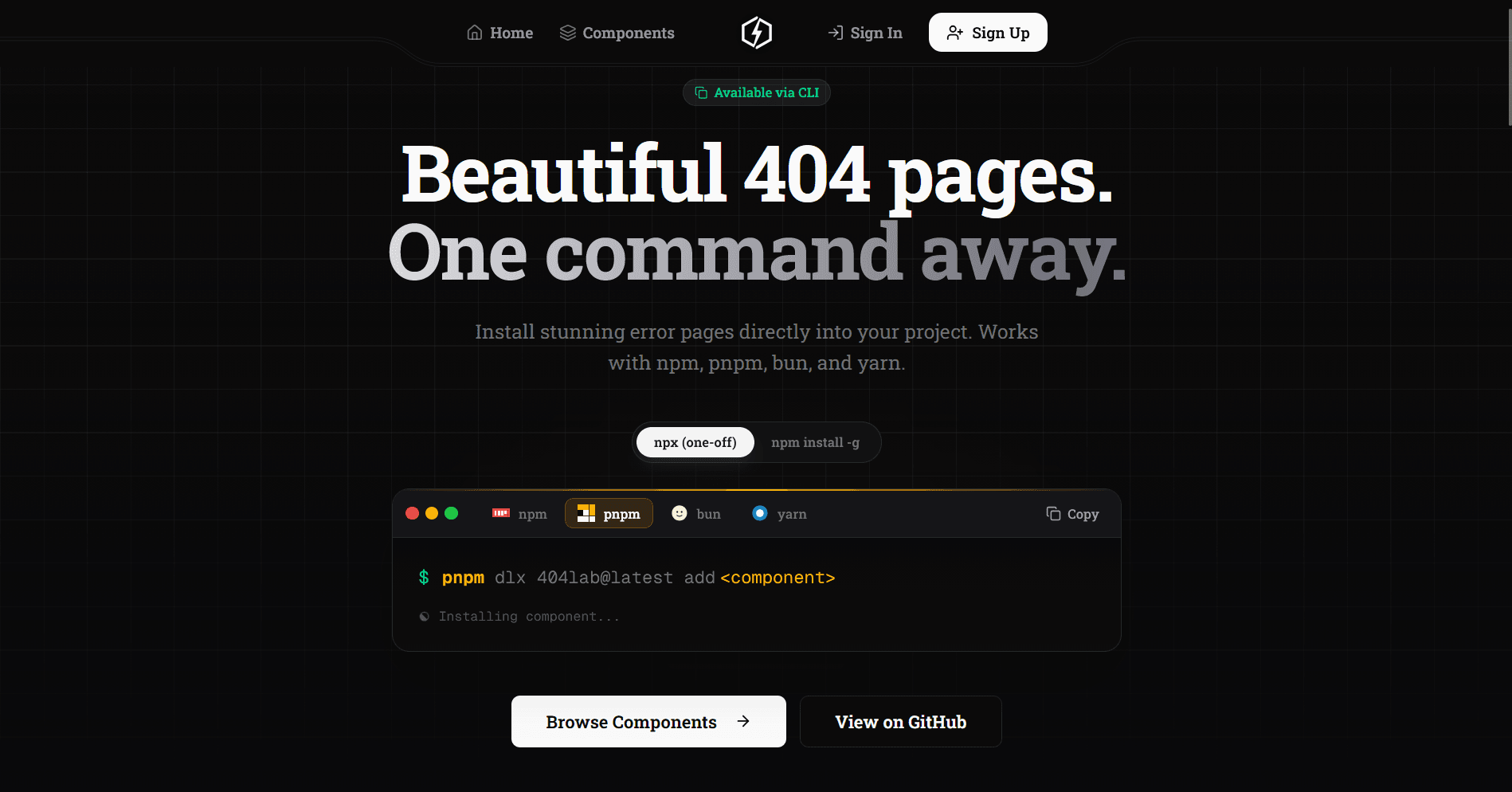
A production-ready collection of beautifully crafted, interactive 404 error page components that transform user frustration into delight. Includes 19+ premium components and a powerful CLI tool for instant integration.
Timeline
6 weeks
Role
Full Stack Developer
Team
Solo
Status
CompletedTechnology Stack
Key Challenges
- Building a CLI tool from scratch
- Creating 19+ unique interactive components
- Integrating Paddle payment system
- Implementing Better Auth with OAuth
- Database design with Prisma
- MDX documentation system
- Complex particle effects
Key Learnings
- Next.js 16 App Router
- CLI development with Node.js
- Payment integration (Paddle)
- Authentication systems (Better Auth)
- Database design (PostgreSQL + Prisma)
- TypeScript advanced patterns
- Component library architecture
- MDX for documentation
- Particle systems (TSParticles)
- OpenAI API integration
404 Lab: Transform Error Pages into Experiences
Overview
404 Lab is a comprehensive, production-ready library that transforms boring error pages into extraordinary experiences. Instead of showing users a generic "Page Not Found" message, this platform provides 19+ beautifully crafted, interactive 404 error page components inspired by popular brands and creative concepts.
The project includes a powerful CLI tool (404Lab CLI) that allows developers to add stunning 404 pages to their Next.js projects with a single command - no manual file copying or configuration required.
What Users Can Do
For Developers
- Browse 19+ Premium Components: Explore carefully crafted designs from minimalist to advanced interactive experiences
- One-Command Installation: Use the CLI tool to add components instantly:
npx 404lab add modern - Live Previews: View interactive component previews before integration
- Copy & Paste Ready: Comprehensive documentation with code examples
- Full Customization: Each component is fully customizable with TypeScript props
- CLI Management: List, add, and remove templates with ease
For End Users
- Engaging Error Pages: Transform frustrating 404 errors into delightful experiences
- Interactive Elements: Play games, explore particle effects, or solve puzzles on error pages
- Brand-Inspired Designs: Choose from templates inspired by Google, Vercel, GeeksforGeeks, and more
- Responsive Experience: All components work seamlessly across devices
Why I Built This
Error pages are often overlooked in web development, yet they're crucial touchpoints in the user journey. I created 404 Lab to solve several problems:
- Generic Error Pages Everywhere: Most websites use boring, unhelpful 404 pages
- User Frustration: Dead ends frustrate users and increase bounce rates
- Time-Consuming Custom Solutions: Building custom error pages takes significant development time
- Lack of Complete Solutions: No comprehensive library existed with CLI integration
- Missing Modern Patterns: Needed a solution using Next.js 13+ App Router and TypeScript
Key Innovations
- CLI Tool Integration: First 404 component library with zero-configuration CLI installation
- 19+ Premium Designs: Largest collection of production-ready 404 components
- Full TypeScript Coverage: Complete type safety across all components
- Authentication & Payments: Enterprise features with Better Auth and Paddle
- MDX Documentation System: Interactive, searchable component documentation
Tech Stack
Frontend
- Next.js 16.1 - React framework with App Router
- React 19 - Latest React features
- TypeScript 5 - Full type safety
- Tailwind CSS 4 - Utility-first styling
- TSParticles - Advanced particle effects
- MDX - Interactive documentation
- Lucide React - Icon library
- next-themes - Dark mode support
Backend & Database
- Prisma - Modern TypeScript-first ORM
- PostgreSQL - Production database (Neon)
- Better Auth - Authentication with Google OAuth
- Paddle - Payment processing
- OpenAI API - AI integration (coming soon)
Tooling
- 404Lab CLI - Custom CLI tool (npm package)
- pnpm - Fast package manager
- ESLint - Code quality
- Vercel - Deployment platform
Featured Components
Basic Components
- SimplePage - Clean, minimalist design
- ModernPage - Contemporary with animations
- Google - Google-inspired layout
- Vercel - Vercel-style error page
Advanced Interactive Components
- Terminal - Interactive CLI experience with command history
- MacOs - macOS system UI with realistic windows
- RetroTV - Vintage TV with scan lines and static
- BlueGlitch - Cyberpunk glitch effects with animations
Particle-Based Components
- Particles - Interactive particle system responding to mouse
- Snow - Falling snow animation with physics
- StrangerThings - 80s sci-fi inspired with particle effects
Themed Components
- AmongUs - Game-inspired with character interactions
- Poet - Artistic, poetic with dynamic text
- StoneAge - Prehistoric themed with illustrations
- GeeksforGeeks - Educational platform style
CLI Tool Features
The 404Lab CLI is a powerful command-line tool that I developed to simplify the integration process:
Commands
# Install globally
npm install -g 404lab

# Add a template
404lab add modern

# List all templates
404lab list

# Remove installed template
404lab remove
Key Features
- Zero Configuration: Works out of the box with Next.js 13+
- Smart File Placement: Automatically creates files in correct directories
- Dependency Management: Detects and prompts for missing dependencies
- Template Previews: Browse templates before installing
- Force Overwrite: Option to replace existing implementations
- Package Manager Detection: Works with npm, yarn, and pnpm
Architecture Highlights
Component Registry System
Built a dynamic component registry that automatically loads and displays components:
// lib/404-components.ts
export const components = [
  {
    name: 'modern',
    title: 'Modern',
    description: 'Contemporary with animations',
    complexity: 'beginner',
    dependencies: [],
  },
  // ... 18+ more components
];
Authentication Flow
Implemented secure authentication with Better Auth:
- Email/password registration
- Google OAuth integration
- Session management
- Protected routes with middleware
- User dashboard
Database Schema
Designed efficient schema with Prisma:
- User profiles with authentication
- Paddle subscription integration
- Session management
- Webhook event handling
Payment Integration
Integrated Paddle for subscription management:
- Sandbox and production environments
- Webhook handling for subscription events
- Customer portal integration
- Price-based billing
Technical Challenges & Solutions
Challenge 1: CLI File Template System
Problem: Needed to distribute component files through npm without bundling.
Solution: Created a template system that stores components as strings and writes them to the correct Next.js directories dynamically.
Challenge 2: Particle Performance
Problem: Complex particle effects caused performance issues.
Solution: Implemented lazy loading, reduced particle counts on mobile, and used requestAnimationFrame for smooth animations.
Challenge 3: TypeScript Types for Dynamic Components
Problem: Dynamic MDX imports needed proper TypeScript types.
Solution: Created custom type definitions and used TypeScript's dynamic import features with proper type guards.
Challenge 4: Paddle Webhook Security
Problem: Needed to verify webhook signatures securely.
Solution: Implemented cryptographic signature verification using Paddle's webhook secret and compared signatures.
Project Highlights
- 19+ Components: Largest collection of production-ready 404 pages
- Full TypeScript: 100% type coverage across entire codebase
- CLI Tool: Published npm package for instant installation
- MDX Documentation: Interactive documentation for each component
- Authentication: Secure user system with OAuth
- Payments: Stripe-quality payment integration with Paddle
- Database: Scalable PostgreSQL with Prisma ORM
- AI Ready: OpenAI integration prepared for future features
Performance Optimization
- Code Splitting: Dynamic imports for component previews
- Lazy Loading: Components load only when needed
- Image Optimization: Next.js Image component throughout
- Font Optimization: next/font for optimal font loading
- Particle Throttling: Reduced particle counts on mobile devices
User Experience Features
- Responsive Design: Mobile-first approach for all components
- Dark Mode by Default: Native dark aesthetic across the platform
- Smooth Animations: Framer Motion and CSS transitions
- Accessibility: ARIA labels and keyboard navigation
- Copy Buttons: One-click code copying
- Live Previews: See components before adding them
Future Enhancements
Q1 2026
- [ ] 10 new component designs
- [ ] Component builder UI with customization
- [ ] A/B testing framework
- [ ] Analytics integration for error tracking
Q2 2026
- [ ] Vue.js and Svelte support
- [ ] Component marketplace
- [ ] Advanced CLI features (interactive picker)
- [ ] Custom theme configuration wizard
Q3 2026
- [ ] Mobile app for browsing components
- [ ] 3D components with Three.js
- [ ] Video background support
- [ ] Real-time collaboration
Impact
This project demonstrates my ability to:
- Build Complete Platforms: Full-stack application with authentication, payments, and database
- Create Developer Tools: Published npm package with CLI tool
- Design Component Systems: Scalable, reusable component architecture
- Write Documentation: Comprehensive MDX-based documentation
- Integrate Third-Party Services: Paddle, Better Auth, OpenAI, Neon
- Optimize Performance: Advanced optimization techniques for animations
- Type Safety: Advanced TypeScript patterns and generics
Live Demo
Visit 404-lab.vercel.app to explore all components, read documentation, and try the CLI tool.
Key Learnings
This project pushed my skills across multiple domains:
- CLI Development: Learned to build professional-grade CLI tools with Node.js
- Payment Systems: Deep dive into payment gateway integration and webhook handling
- Authentication: Implemented secure auth systems with OAuth flows
- Database Design: Created efficient schemas for multi-tenant applications
- Component Architecture: Built scalable, reusable component libraries
- Documentation: Mastered MDX for interactive technical documentation
- TypeScript: Advanced patterns including generics and type guards
- Performance: Optimized complex animations and particle systems
Conclusion
404 Lab transforms the often-overlooked 404 error page into an opportunity for engagement and delight. With 19+ production-ready components, a powerful CLI tool, and enterprise-grade features, it's a complete solution for developers who want to provide exceptional user experiences at every touchpoint—even error pages.